
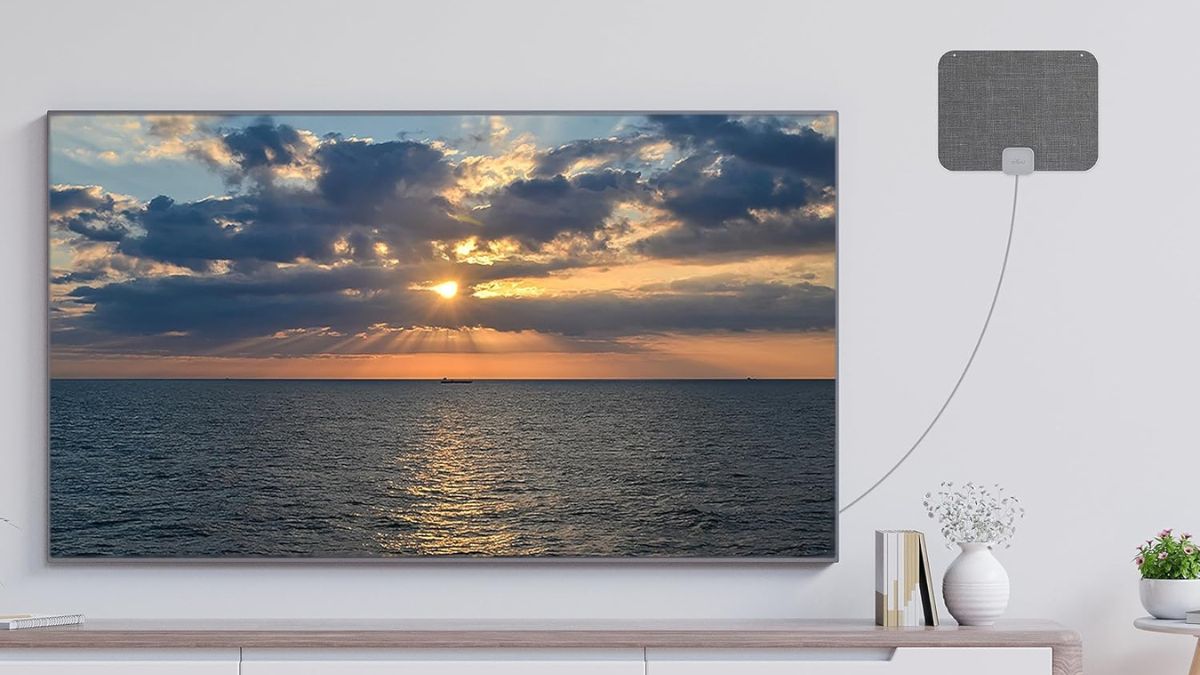
Seventeen years ago today, at midnight on June 12, 2009, the last analog television signals in the United States went dark forever. After decades of black-and-white rabbit ears, rooftop antennas, and the familiar hiss and snow of a weak signal, the nation’s full-power broadcast stations completed their mandatory switch to digital transmission — closing the curtain on an era that had defined home entertainment for more than half a century.
It was the end of one chapter and the beginning of another, and for millions of Americans who still relied on over-the-air reception, it was a moment that demanded action, preparation, and for some, a frustrating scramble to keep their televisions working at all.
A Brief History of Over-the-Air Television
Long before cable bundles, streaming subscriptions, and satellite dishes, there was simply the antenna. Over-the-air (OTA) broadcasting was the original and only way Americans watched television, and its roots stretch back to the earliest days of the medium itself.
Experimental television broadcasts began in the United States in the late 1920s and early 1930s, with NBC making some of the first regular broadcasts from the Empire State Building in New York City. By 1941, the Federal Communications Commission had authorized commercial television broadcasting, and the first licensed commercial stations began transmitting on the VHF band — Very High Frequency — using channels 2 through 13.
The post-World War II economic boom supercharged the industry. By the early 1950s, television sets were appearing in living rooms across the country at a staggering pace. Families gathered around bulky cathode-ray tube sets, adjusting rabbit-ear antennas — so called for their V-shaped dipole design — to pull in signals from local network affiliates carrying programming from ABC, CBS, and NBC. Reception was an art form. Tilting one ear of the antenna, wrapping aluminum foil around the tips, or rotating a rooftop aerial on a windy night was simply part of the television-watching experience.
The UHF band — Ultra High Frequency, covering channels 14 through 83 — was added to the broadcast spectrum in 1952, greatly expanding the number of available channels. However, most early television sets could not receive UHF without a separate converter, a problem Congress eventually addressed with the All-Channel Receiver Act of 1962, which required all new sets sold in the U.S. to include both VHF and UHF tuners.
Through the 1960s and 1970s, OTA television was king. Three major networks dominated the airwaves, and the antenna was the great equalizer — rich or poor, urban or rural, any household with a set and a clear line of sight to a broadcast tower could watch the moon landing, the Super Bowl, or the nightly news without paying a dime beyond the cost of the television itself.
Cable television began its slow encroachment in the 1970s and accelerated dramatically through the 1980s and 1990s. By the turn of the millennium, a majority of American households had subscribed to cable or satellite service, and the antenna had come to be seen as a relic — something for those who could not afford the monthly bill, or for cabins deep in the countryside.
The Long Road to Digital
The push toward digital broadcasting in the United States began in earnest in the mid-1990s. The FCC formally adopted the Advanced Television Systems Committee (ATSC) digital television standard in 1996, and Congress passed the Telecommunications Act of the same year, which set the framework for the transition. Full-power stations were assigned paired digital channels and given a deadline — originally 2006 — to complete the switchover, after which they would surrender their analog spectrum.
The transition was about far more than picture quality. The federal government had its eye on the valuable spectrum that analog broadcasting occupied. Reclaiming those frequencies meant new revenue from spectrum auctions and new capacity for public safety communications, a priority that had become urgent after the communication failures of September 11, 2001.
The original 2006 deadline slipped repeatedly as Congress grappled with the complexity of the changeover. Roughly 15 percent of American households — around 20 million homes — still relied exclusively on over-the-air analog reception as the deadline approached, and lawmakers were rightly concerned about leaving those viewers without a signal. A $1.5 billion federal coupon program was established to help viewers obtain digital-to-analog converter boxes, which would allow older analog televisions to receive the new digital broadcasts.
The final hard deadline was set for February 17, 2009. Then came one more delay. The coupon program ran out of funds, leaving more than a million households on a waiting list, and President Barack Obama’s administration, just weeks into office, pushed Congress to move the date to June 12, 2009. Most stations made the leap in February anyway, but the stragglers — and the full legal completion of the transition — waited until that June date.
The Day the Snow Disappeared
On the morning of June 12, 2009, the final full-power analog transmitters shut down. The familiar static and ghostly double images of a weak signal were replaced, for those with the right equipment, by a sharply defined digital picture — and for those without, by a completely blank screen.
The transition delivered genuine improvements. Digital broadcasting provided significantly sharper picture quality, the ability for stations to broadcast multiple subchannels over a single frequency, and better use of the available spectrum. A single station that once occupied one analog channel could now offer a primary HD feed alongside several standard-definition subchannels, effectively multiplying the number of available OTA channels overnight.
The Antenna’s Quiet Comeback
What few predicted in 2009 was that the digital transition would eventually help spark a renaissance for over-the-air television. As cable and satellite bills climbed steadily through the 2010s and streaming services proliferated in the 2020s, a growing number of Americans rediscovered the antenna. The economics were simple: a one-time antenna purchase of anywhere from twenty to a hundred dollars could deliver dozens of free, crystal-clear digital channels — local news, network programming, weather, classic movies, and more — with no monthly fee attached.
The cord-cutting movement that reshaped the television industry found an unlikely ally in the same over-the-air infrastructure that had existed since the Truman administration. Today, industry estimates suggest that tens of millions of American households use an antenna as either their primary or supplementary source of television, a number that has grown consistently for more than a decade.
Seventeen years on, the June 12 transition stands as one of the most significant single-day events in the history of American broadcasting — a technological handoff that closed the analog age and, in a twist no one quite saw coming, helped ensure that the simple act of putting up an antenna and watching free television would endure well into the 21st century.
Please add Cord Cutters News as a source for your Google News feed HERE. You can watch today’s top cord cutting stories on our YouTube channel HERE. Please follow us on Facebook and X for more news, tips, and reviews. Need cord cutting tech support? Join our Cord Cutting Tech Support Facebook Group for help.