
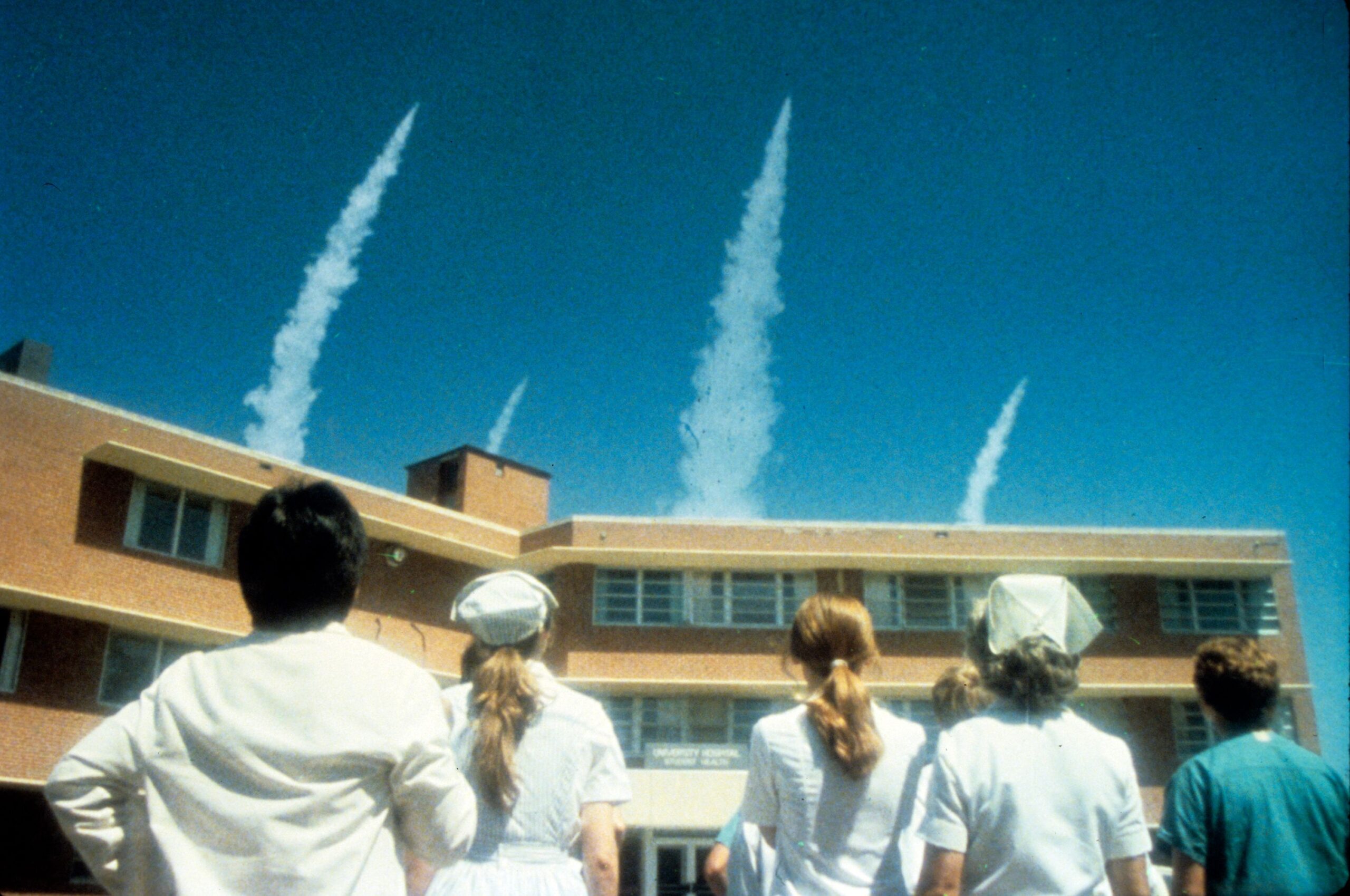
Exactly 42 years ago, on Sunday evening, November 20, 1983, an estimated 100 million people – roughly 38% of the entire U.S. population and the largest audience ever for a made-for-television movie – sat transfixed in front of their sets as ABC aired The Day After, a harrowing two-hour dramatization of the moments before, during, and after a full-scale nuclear exchange between the United States and the Soviet Union.
You can find The Day After on Amazon HERE.
Directed by Nicholas Meyer (fresh off Star Trek II: The Wrath of Khan) and produced by ABC’s own Motion Picture Division, the $7 million film was shot in and around Lawrence, Kansas, deliberately chosen as an “every-town” in the American heartland. The cast included familiar television faces – Jason Robards as a doctor, JoBeth Williams as a nurse, John Lithgow as a university professor, Steve Guttenberg as a young farmer – along with dozens of Kansas locals. What made the film unforgettable, however, was not star power but its unflinching realism: mushroom clouds rising over Kansas City, electromagnetic pulses frying electronics, hospital corridors overflowing with radiation victims whose hair falls out in clumps, and the slow, gray realization that civilization as Americans knew it had ended in less than an hour.
The project began in 1981 when ABC Entertainment president Brandon Stoddard, alarmed by escalating Cold War rhetoric and the Reagan administration’s talk of “winnable” nuclear war, commissioned writer Edward Hume to craft a script that would show the human cost of such a conflict. Director Nicholas Meyer insisted on clinical accuracy; he consulted scientists from the RAND Corporation, the Federation of American Scientists, and even former Secretary of Defense Robert McNamara. Makeup artist Zoltan Elek spent weeks studying photographs of Hiroshima and Nagasaki survivors to recreate radiation burns that still shock viewers today.
When word spread about the film’s graphic content, controversy erupted before a single frame aired. The Reagan White House privately worried it would fuel the growing nuclear-freeze movement. Conservative columnists called it anti-American propaganda. Some ABC affiliates in the South and Midwest threatened not to carry it. In the end, every affiliate aired the movie, though many ran lengthy disclaimers and several inserted extra commercial breaks to give viewers “time to collect themselves.”
The broadcast itself was an event unlike anything television had attempted. ABC cleared two hours of prime time with no commercial interruptions during the attack sequence itself – an almost unheard-of decision. Viewers remember the silence in living rooms across the country as the missiles launched and the screen filled with white-hot detonations. Phone lines to ABC switchboards lit up; psychologists and clergy appeared on post-broadcast discussion panels; schools the next day reported children afraid to go outdoors.
President Ronald Reagan watched a pre-airing copy at Camp David and wrote in his diary that the film left him “greatly depressed.” Three weeks later, he signed the Intermediate-Range Nuclear Forces Treaty with Mikhail Gorbachev – the first agreement to actually reduce nuclear arsenals. Reagan later told aides that The Day After had influenced his thinking more than any briefing paper.
In the decades since, the film has been credited with (or blamed for) shifting public opinion decisively against the idea that nuclear war could ever be “limited” or survivable. It aired in the Soviet Union in 1987, introduced by physicist and dissident Andrei Sakharov. High-school and college classes still screen it in units on the Cold War. Restored prints occasionally play in art-house theaters, where younger audiences – raised on superhero apocalypses – are stunned by its restraint: no swelling soundtrack during the blasts, no heroic last stands, just ordinary people vaporized or condemned to slow death by fallout.
Forty-two years later, with a new generation debating nuclear modernization, arms control treaties in tatters, and great-power tensions rising again, The Day After remains the closest mainstream American culture has ever come to looking directly into the abyss – and the most-watched reminder that once the missiles fly, there is no reset button.
You can find The Day After on Amazon HERE.
Please add Cord Cutters News as a source for your Google News feed HERE. Please follow us on Facebook and X for more news, tips, and reviews. Need cord cutting tech support? Join our Cord Cutting Tech Support Facebook Group for help.