
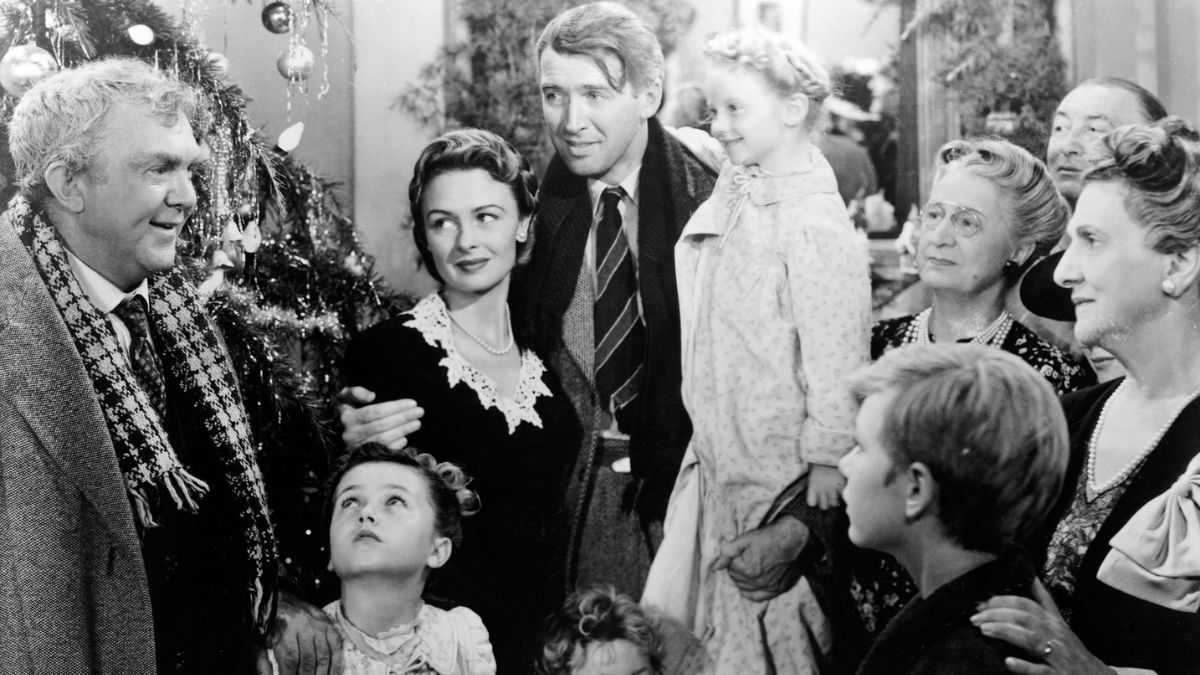
As the holiday season wraps the world in festive cheer, film enthusiasts and nostalgia buffs alike are commemorating a pivotal moment in cinematic history. Exactly 79 years ago today, on December 20, 1946, Frank Capra’s heartfelt drama It’s a Wonderful Life made its debut at New York City’s Globe Theatre. The premiere, initially a charity preview showing one day ahead of its wider release, introduced audiences to a story that would eventually become synonymous with Christmas spirit, hope, and redemption – though its path to iconic status was anything but straightforward.
You can watch It’s A Wonderful Life with Prime Video in Black & White HERE or in Color HERE.
Starring James Stewart as the everyman hero George Bailey, Donna Reed as his devoted wife Mary, and Lionel Barrymore as the villainous banker Mr. Potter, the film was Capra’s first major project after serving in World War II. Produced by Liberty Films, Capra’s independent production company, and distributed by RKO Radio Pictures, It’s a Wonderful Life was budgeted at a hefty $3.7 million – a significant sum for the era. The story follows George Bailey, a small-town building and loan operator in Bedford Falls, who faces financial ruin and despair on Christmas Eve. Contemplating suicide, he’s visited by his guardian angel, Clarence (played by Henry Travers), who shows him an alternate reality where he never existed, highlighting the profound impact one life can have on a community.
The origins of It’s a Wonderful Life trace back to a modest short story titled “The Greatest Gift,” written by Philip Van Doren Stern in 1939. Unable to find a publisher, Stern printed 200 copies as Christmas cards in 1943 and sent them to friends and family. One copy landed in the hands of producer David Hempstead, who passed it to Cary Grant’s agent. Grant was initially attached to star, but the project evolved when Capra acquired the rights for $10,000 in 1945. Capra, known for uplifting classics like Mr. Smith Goes to Washington and It Happened One Night, saw potential in the tale’s themes of self-sacrifice and human kindness, especially resonant in the post-war years when many Americans were grappling with readjustment to civilian life.
Filming took place from April to July 1946, primarily on a massive set built in Encino, California, which included a 300-yard-long Main Street and over 75 buildings to represent Bedford Falls. To create the film’s snowy scenes, Capra’s team innovated a new artificial snow made from foamite (a fire-fighting chemical), water, and soap flakes, ditching the traditional painted cornflakes that were too noisy underfoot. James Stewart, fresh from his own wartime service as a bomber pilot, brought a raw vulnerability to George Bailey, drawing from his personal experiences of post-traumatic stress. Donna Reed, in one of her breakout roles, won audiences over with her portrayal of the steadfast Mary, even learning to throw a rock through a window for an iconic scene – though a stuntman ultimately did the throw.
Despite high expectations, the film’s initial reception was lukewarm at best. Released amid a crowded holiday season and competing with blockbusters like The Best Years of Our Lives, It’s a Wonderful Life underperformed at the box office, earning only about $3.3 million against its costs and resulting in a loss of around $525,000 for RKO. Critics were divided; while some praised its sentimental warmth, others dismissed it as overly saccharine “Capra-corn.” The movie received five Academy Award nominations, including Best Picture, Best Director, and Best Actor for Stewart, but walked away empty-handed at the 1947 Oscars.
The film’s renaissance began in the 1970s, thanks to a clerical error. In 1974, the copyright lapsed due to a failure to renew, allowing television stations to broadcast it royalty-free during the holidays. This exposure turned It’s a Wonderful Life into an annual tradition, embedding it in American pop culture. NBC acquired exclusive rights in 1994 after the copyright was reinstated in 1993, but by then, its status as a beloved classic was sealed. The American Film Institute ranks it as the 20th greatest American film of all time, and it’s inspired countless parodies, homages, and adaptations, from Saturday Night Live sketches to stage musicals.
Fun trivia abounds: The young actress who played Zuzu Bailey, Karolyn Grimes, delivered the famous line, “Every time a bell rings, an angel gets his wings.” The film also features a rare on-screen appearance by a raven named Jimmy, who appeared in several Capra films. And in a nod to real-life inspiration, the character of Uncle Billy (Thomas Mitchell) was based on Stern’s own forgetful relative.
You can watch It’s A Wonderful Life with Prime Video in Black & White HERE or in Color HERE.
Today, 79 years after its New York premiere, It’s a Wonderful Life endures as a reminder of resilience and community. In an era of streaming and CGI spectacles, its black-and-white simplicity continues to resonate, proving that true holiday magic lies in the human connections we often take for granted. As George Bailey learns, no one is a failure who has friends – a message that feels as vital now as it did in 1946.
Please add Cord Cutters News as a source for your Google News feed HERE. Please follow us on Facebook and X for more news, tips, and reviews. Need cord cutting tech support? Join our Cord Cutting Tech Support Facebook Group for help.