
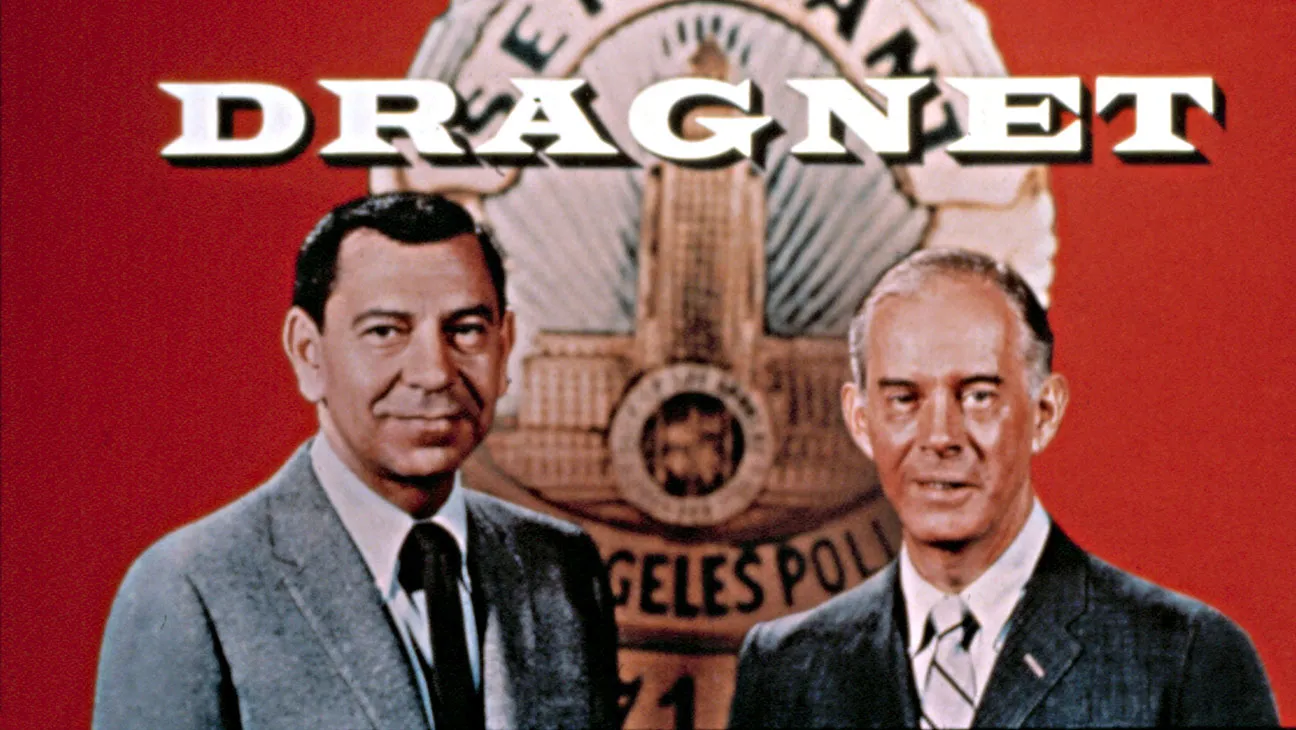
In the annals of television history, few shows have left as indelible a mark on the crime drama genre as Dragnet. Today, as we reflect on events from 59 years ago, we commemorate the revival of Jack Webb’s groundbreaking police procedural on NBC. On January 12, 1967—amid a turbulent era of social change, Vietnam War protests, and the Summer of Love—the network debuted the colorized version of Dragnet, bringing Sergeant Joe Friday back to living rooms across America. This revival, which ran through April 16, 1970, not only reintroduced a beloved format but also adapted it to the vibrant, technicolor world of 1960s television, marking a pivotal shift in how crime stories were told on the small screen.
You can find Dragnet on Amazon HERE.
The 1967 iteration, often titled Dragnet 1967 to distinguish it from its predecessor, aired on Thursday nights from 9:30 to 10:00 p.m. ET. Jack Webb reprised his role as the stoic, fact-driven Sgt. Joe Friday, now partnered with Harry Morgan as Officer Bill Gannon. The duo tackled cases drawn from real Los Angeles Police Department files, emphasizing procedural accuracy with Webb’s signature narration: “The story you are about to see is true. The names have been changed to protect the innocent.” This revival consisted of 98 episodes across four seasons, evolving the show’s title each year—Dragnet 1968, 1969, and 1970—to reflect its ongoing timeliness. Broadcast in full color for the first time, it captured the era’s visual flair while delving into contemporary issues like drug abuse, counterculture movements, and urban crime.
To understand the significance of this revival, one must delve into the short but storied history of the Dragnet franchise. It all began on radio in 1949, when Jack Webb, a former radio actor, created a police drama for NBC inspired by his experiences shadowing LAPD officers. The radio series, which ran until 1957, pioneered the “police procedural” style—focusing on methodical investigations rather than melodramatic twists. Webb’s deadpan delivery of “Just the facts, ma’am” (a phrase often misattributed but emblematic of the show’s no-nonsense tone) became a cultural catchphrase.
The transition to television came swiftly. The original Dragnet TV series premiered on NBC on December 16, 1951, as a midseason replacement following a successful pilot. Starring Webb as Friday alongside initial partner Barton Yarborough (who passed away shortly after filming began) and later Ben Alexander as Officer Frank Smith, it aired in black and white for eight seasons until 1959, producing 276 episodes. This run was revolutionary: It was one of the first TV shows to spawn a feature film (the 1954 Dragnet movie, also starring Webb) and introduced docudrama elements, using actual LAPD cases and technical advisors for authenticity. At its peak, it drew over 38 million viewers weekly, outpacing many competitors and solidifying the procedural format that would influence shows like CSI and Law & Order decades later.
By the mid-1960s, Webb’s career had waned, but he saw an opportunity to revive Dragnet amid rising interest in realistic cop shows. The 1967 version was greenlit after a 1966 TV movie pilot, Dragnet, tested the waters. What set this revival apart was its embrace of color broadcasting, which was becoming standard on NBC. Episodes vividly depicted the LAPD’s inner workings, from homicide investigations to narcotics busts. Notably, the show addressed the psychedelic counterculture head-on. The premiere episode, “The LSD Story” (airing January 12, 1967), featured Friday and Gannon confronting a face-painted teen high on acid—a stark commentary on the drug epidemic. Other installments like “The Big High” explored marijuana use, while “The Big Prophet” satirized figures akin to Timothy Leary. These stories blended Webb’s conservative worldview with the era’s social upheavals, often portraying hippies and radicals as misguided or dangerous, which sparked both praise and criticism.
The revival’s impact was profound. It humanized police officers, showing their daily lives beyond the badge—Friday and Gannon discussed family, hobbies, and even diets in lighter moments. Directed entirely by Webb, it maintained the original’s minimalist style: sparse sets, rapid dialogue, and that iconic theme music by Walter Schumann (later remixed for the revival). Ratings remained solid, though not as dominant as the 1950s version, and it ended in 1970 amid changing viewer tastes toward more action-oriented fare like Hawaii Five-O.
Dragnet’s legacy endures. It spawned further iterations, including a short-lived 1989 syndicated series, a 2003 reboot with Ed O’Neill, and even comedic parodies like the 1987 film starring Tom Hanks and Dan Aykroyd. Webb, who passed away in 1982, is remembered as a TV pioneer who bridged radio, film, and television. The LAPD honored him by retiring badge number 714 (Friday’s fictional badge) and flying flags at half-mast.
As we look back 59 years, Dragnet 1967 reminds us of television’s power to reflect society’s underbelly. In an age of streaming procedurals, its emphasis on facts over fiction feels timeless. Whether you’re a longtime fan or discovering it via reruns, the show’s mantra holds: Just the facts—and they’ve never been more compelling.
You can find Dragnet on Amazon HERE.
Please add Cord Cutters News as a source for your Google News feed HERE. Please follow us on Facebook and X for more news, tips, and reviews. Need cord cutting tech support? Join our Cord Cutting Tech Support Facebook Group for help.