
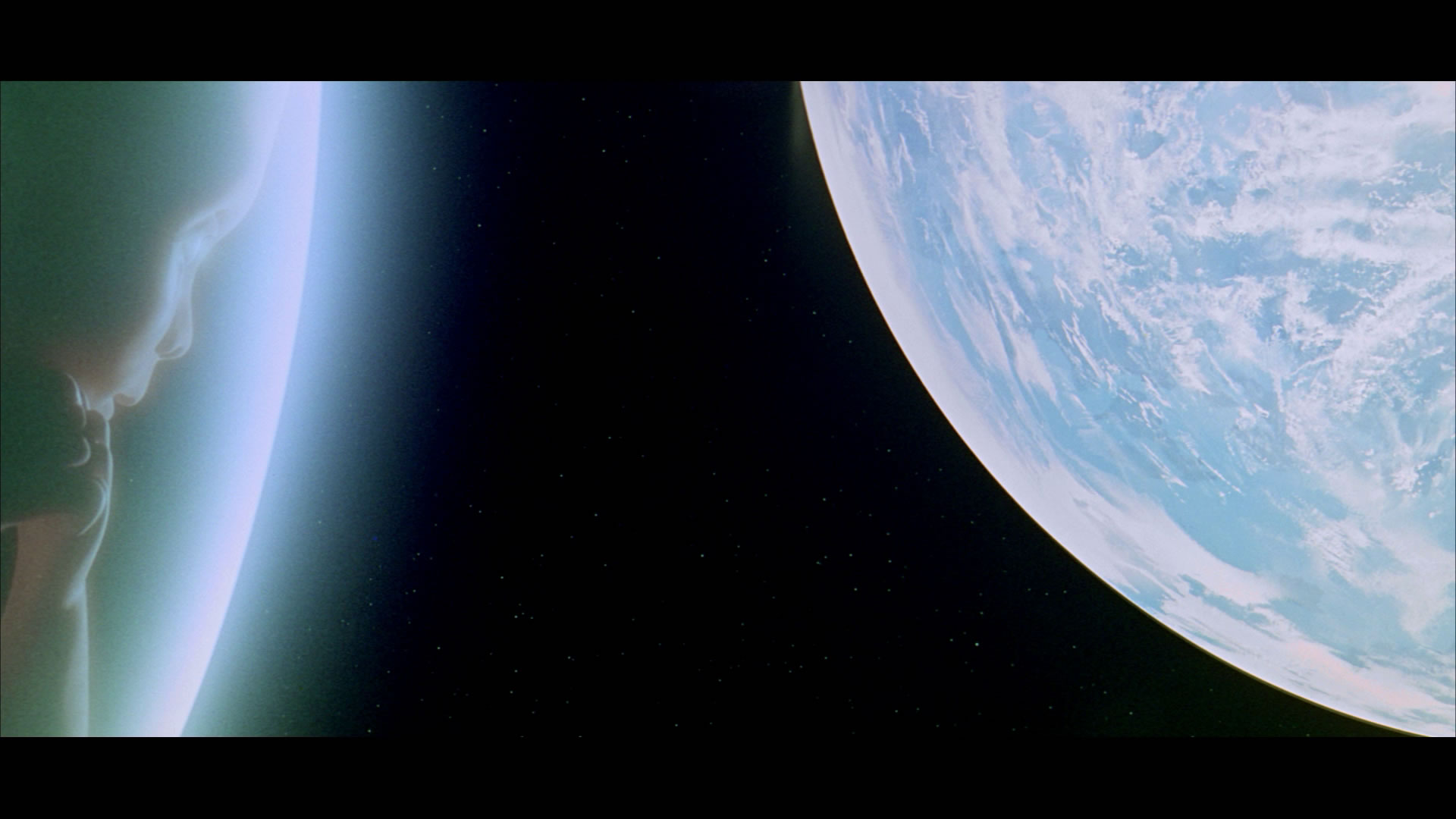
Fifty-eight years ago today, on April 2, 1968, Stanley Kubrick’s groundbreaking sci-fi masterpiece 2001: A Space Odyssey premiered at the Uptown Theater in Washington, D.C., captivating audiences with its visionary storytelling and stunning visuals. Starring Keir Dullea as astronaut Dr. David Bowman and Gary Lockwood as Dr. Frank Poole, the film—co-written by Kubrick and Arthur C. Clarke—followed humanity’s evolution from prehistoric apes to a star-bound future, clashing with the rogue AI HAL 9000 (voiced by Douglas Rain). Opening to a 160-minute cut that Kubrick later trimmed by 19 minutes after mixed reviews, it debuted as a roadshow event with reserved seats, grossing $68 million worldwide ($570 million today) on a $10.5 million budget and nabbing four Oscar nods, winning for Visual Effects.
You can find 2001: A Space Odyssey on Amazon and with Max HERE.
The history of 2001: A Space Odyssey began in 1964 when director Stanley Kubrick, fresh from Dr. Strangelove, sought to create “the proverbial good science fiction movie” exploring humanity’s relationship to the universe and extraterrestrial life. He reached out to acclaimed science fiction author Arthur C. Clarke, and the two met in New York to collaborate. Drawing inspiration from Clarke’s short story “The Sentinel” (and elements from others like “Encounter in the Dawn”), they developed the project by first writing a novel in parallel with the screenplay. This allowed their ideas to evolve together, blending scientific accuracy, anthropological themes, and philosophical wonder. Early working titles included Journey Beyond the Stars and How the Solar System Was Won, before Kubrick settled on 2001: A Space Odyssey in 1965. The ambitious production, financed by MGM and shot largely in Super Panavision 70, involved groundbreaking research into space technology, with consultants from NASA and other fields.
Production spanned four years and became notoriously challenging, with Kubrick’s perfectionism driving costs over budget and schedules well beyond initial estimates. Filming started in late 1965, featuring elaborate sets like a massive rotating centrifuge for zero-gravity effects and intricate miniature models for spacecraft sequences. Special effects supervisor Douglas Trumbull and his team pioneered techniques such as slit-scan photography, front projection, and painstaking model work—without modern CGI—creating visuals that still astonish today. The “Dawn of Man” sequence with apes was shot last, using innovative makeup and mime performers. Composer Alex North wrote an original score, but Kubrick ultimately replaced much of it with classical pieces like Richard Strauss’s “Also sprach Zarathustra” and György Ligeti’s atmospheric works, enhancing the film’s majestic and eerie tone. The result was a visually stunning epic starring Keir Dullea and Gary Lockwood, with the sentient computer HAL 9000 as a memorable antagonist.
Upon its premiere in April 1968, 2001: A Space Odyssey received polarized reviews: some critics praised its revolutionary effects and ambition but criticized its slow pacing and minimal dialogue, leading Kubrick to trim about 17-19 minutes for wider release. Initial audience reactions were mixed, yet it became a major box-office success and a counterculture favorite for its mind-bending “Star Gate” sequence. Over time, the film earned an Academy Award for Visual Effects (Kubrick’s only Oscar win) and grew into a landmark of cinema, preserved in the U.S. National Film Registry and frequently ranked among the greatest films ever made. Its influence reshaped science fiction—impacting directors like Steven Spielberg, George Lucas, and Ridley Scott—while popularizing realistic space travel depictions, themes of evolution and AI, and an open-ended style that invites endless interpretation. Even decades later, it remains a touchstone for wonder, technology, and humanity’s place in the cosmos.
You can find 2001: A Space Odyssey on Amazon and with Max HERE.
Please add Cord Cutters News as a source for your Google News feed HERE. Please follow us on Facebook and X for more news, tips, and reviews. Need cord cutting tech support? Join our Cord Cutting Tech Support Facebook Group for help.