
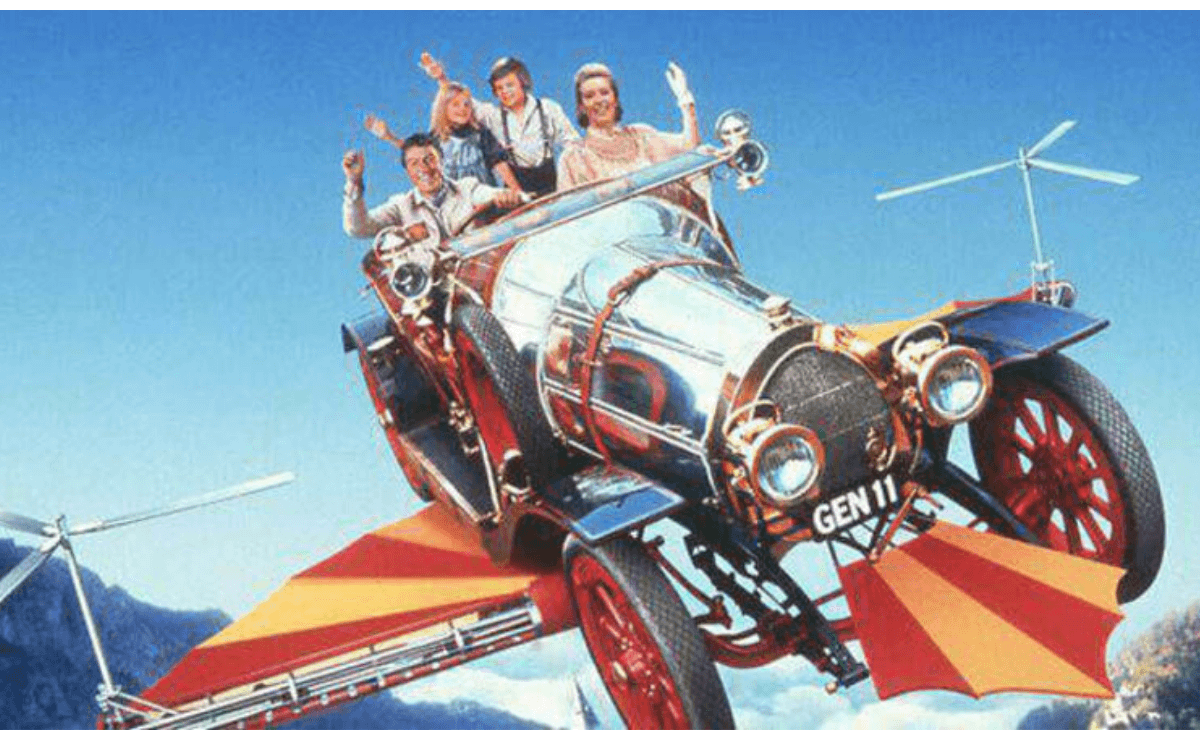
Today marks the 57th anniversary of a whimsical milestone in cinematic history: the royal premiere of the musical-fantasy film Chitty Chitty Bang Bang at the iconic Odeon Leicester Square theater in London on December 16, 1968. This enchanting production, blending adventure, invention, and song, captivated audiences with its tale of a flying car and a family’s daring exploits, becoming a beloved family classic despite its initial mixed reception.
You can find Chitty Chitty Bang Bang on Amazon HERE or on Disney+.
The premiere was a glittering affair, attended by royalty and celebrities, fitting for a film that promised to transport viewers to a world of magic and machinery. Directed by Ken Hughes and co-written by Hughes and the legendary children’s author Roald Dahl, the movie starred Dick Van Dyke as the inventive widower Caractacus Potts and Sally Ann Howes as the elegant Truly Scrumptious. The soundtrack, featuring memorable tunes like the titular “Chitty Chitty Bang Bang” and “Truly Scrumptious,” was crafted by the acclaimed Sherman Brothers—Richard M. and Robert B. Sherman—who had previously enchanted the world with their work on Mary Poppins. The event at Odeon Leicester Square was part of a roadshow release strategy by United Artists, aiming to replicate the blockbuster success of films like The Sound of Music. Following the London debut, the film opened in the UK on December 17 and in the US on December 18, 1968, with a runtime of 145 minutes that promised epic family entertainment.
The story behind Chitty Chitty Bang Bang is as fascinating as the film itself. It all began with Ian Fleming, the creator of James Bond, who penned the original children’s novel Chitty-Chitty-Bang-Bang: The Magical Car in 1964 while recovering from a heart attack. Inspired by bedtime stories for his son, Fleming’s book—published posthumously in three volumes—featured a magical car that could fly and float, drawing from real-life racing cars of the early 20th century. Producer Albert R. Broccoli, Fleming’s collaborator on the Bond series, acquired the rights and saw potential in adapting it as a family musical, especially after the triumph of Mary Poppins. However, Broccoli proceeded without his usual partner Harry Saltzman, forming a joint production between Warfield Productions and Dramatic Features.
Production kicked off in earnest in 1967, with filming spanning from July to October across picturesque locations in England, France, and West Germany. Key sites included Neuschwanstein Castle in Bavaria for the villainous Baron Bomburst’s lair, Cobstone Windmill in Buckinghamshire as Potts’ quirky home, and the beaches of Saint-Tropez for seaside adventures. The budget ballooned to between $10 million and $12 million, largely due to elaborate special effects supervised by John Stears, who created six versions of the iconic car—only one of which was fully roadworthy. Designer Ken Adam brought the vehicle to life, complete with retractable wings and flotation devices, while artist Rowland Emett crafted Potts’ outlandish inventions, dubbed “fantasticators.”
The plot, set in 1910s England, follows Caractacus Potts, a struggling inventor and single father to twins Jemima and Jeremy (played by Heather Ripley and Adrian Hall). With the help of candy heiress Truly Scrumptious, they restore a dilapidated racing car into the magical Chitty Chitty Bang Bang. Their journey leads to the fictional land of Vulgaria, ruled by the tyrannical Baron Bomburst (Gert Fröbe) and his child-hating Baroness (Anna Quayle), where they battle the sinister Child Catcher (Robert Helpmann) and free imprisoned children. The narrative weaves real-world romance with fantastical elements, including Chitty’s transformations into a boat and airplane, all underscored by the Sherman Brothers’ catchy score, which earned an Academy Award nomination for Best Original Song.
Casting was a highlight of the production. Dick Van Dyke, fresh off Mary Poppins, brought his signature charm and physical comedy to Potts, while Sally Ann Howes stepped in after Julie Andrews declined the role for its similarities to her previous work. The ensemble included comedy legends like Benny Hill as the Toymaker and Lionel Jeffries as Grandpa Potts, adding layers of humor and heart. Choreography by Marc Breaux and Dee Dee Wood ensured the musical numbers popped with energy.
Upon release, Chitty Chitty Bang Bang received mixed reviews. Critics like Roger Ebert hailed it as a top children’s film for its inventive spirit, but others, such as Renata Adler of The New York Times, noted its density and length—some suggested it could have been trimmed to 90 minutes. Box-office-wise, it ranked as the tenth-most popular film in the US in 1969 but incurred losses of around $8 million for United Artists due to its high costs. Over time, however, its reputation has soared, earning a 70% approval on Rotten Tomatoes and praise for its enduring magic.
The film’s legacy endures through various adaptations, including a 2002 stage musical that added new Sherman songs and ran successfully on the West End and Broadway, as well as international tours. Home media releases, from VHS to Blu-ray, have kept it accessible, and collectibles like Corgi Toys’ model cars remain popular. A remake is reportedly in early development by Amazon MGM Studios and Eon Productions, promising to introduce the story to new generations. Fifty-seven years on, Chitty Chitty Bang Bang reminds us of cinema’s power to spark imagination, proving that with a bit of invention and melody, even the ordinary can become extraordinary.
You can find Chitty Chitty Bang Bang on Amazon HERE or on Disney+.
Please add Cord Cutters News as a source for your Google News feed HERE. Please follow us on Facebook and X for more news, tips, and reviews. Need cord cutting tech support? Join our Cord Cutting Tech Support Facebook Group for help.