
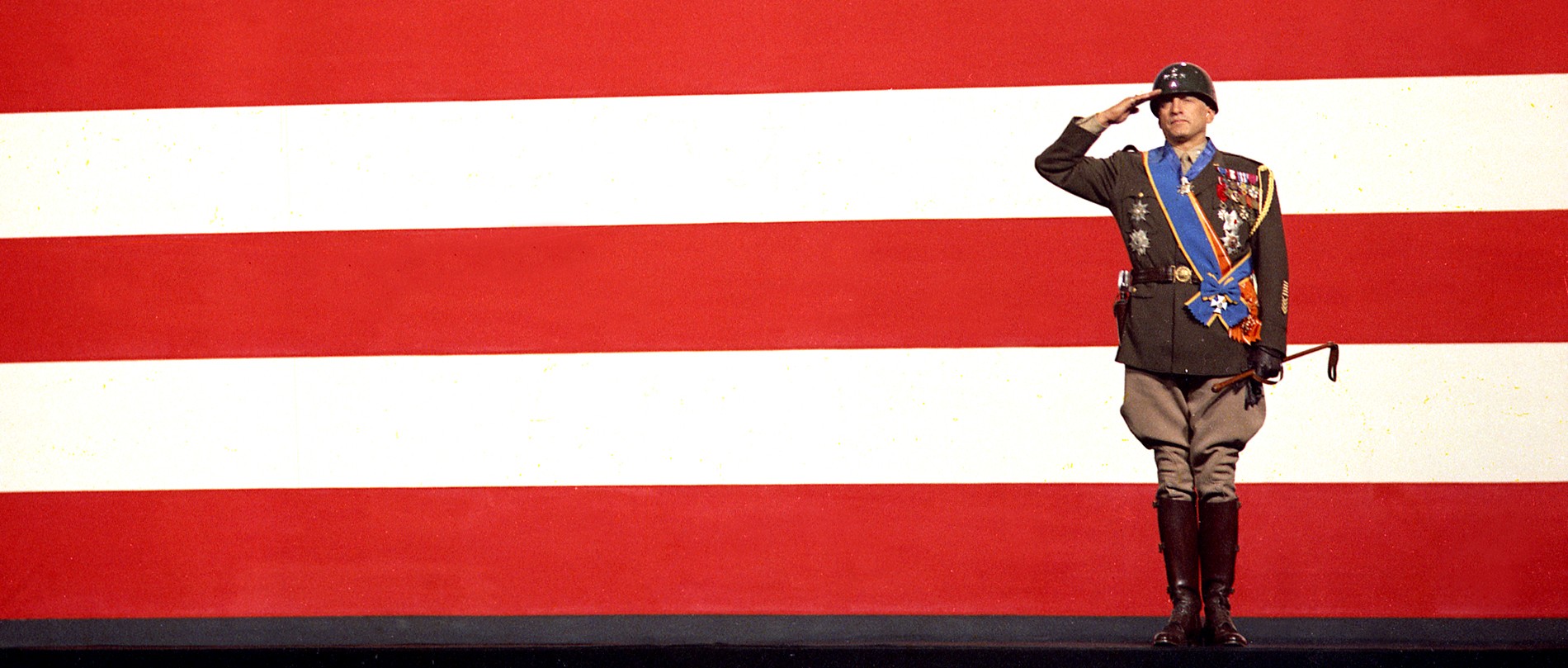
Today marks the 56th anniversary of a pivotal moment in cinematic history: the premiere of the epic biographical film Patton at the Criterion Theatre in New York City on February 4, 1970. Directed by Franklin J. Schaffner and starring the inimitable George C. Scott in the title role, the film brought to life the controversial and brilliant U.S. General George S. Patton during World War II. While the Vietnam War raged on and anti-war sentiments simmered in America, Patton emerged as a complex portrait of military leadership, blending admiration with critique in a way that resonated deeply with audiences and critics alike. Its release not only honored a larger-than-life figure but also sparked debates about war, heroism, and the human cost of conflict—themes that feel strikingly relevant even today.
You can find the movie Patton on Amazon HERE.
The film’s opening scene alone became legendary: Scott, as Patton, stands before a massive American flag, delivering a fiery monologue that sets the tone for the entire movie. “No bastard ever won a war by dying for his country,” he declares. “He won it by making the other poor dumb bastard die for his country.” This speech, adapted from real addresses by the general, encapsulated Patton’s unyielding philosophy and Scott’s powerhouse performance, which would earn him an Academy Award—though he famously refused to accept it, decrying the Oscars as a “meat parade.”
Patton follows the general’s exploits from the North African campaign in 1943, through the invasion of Sicily, and into the heart of Europe after D-Day. It portrays him as a tactical genius, revitalizing demoralized troops and outmaneuvering German forces, but also as a volatile egomaniac prone to outbursts, including the infamous incident where he slaps a shell-shocked soldier. Karl Malden co-stars as General Omar Bradley, providing a grounded counterpoint to Patton’s flamboyance. The screenplay, penned by Francis Ford Coppola and Edmund H. North, drew from Ladislas Farago’s biography Patton: Ordeal and Triumph and Bradley’s memoir A Soldier’s Story, weaving historical accuracy with dramatic flair. But the road to the screen was as tumultuous as Patton’s own career. The idea for the film originated in 1951, when producer Frank McCarthy, a former staff officer under General George C. Marshall during WWII, pitched it to 20th Century Fox head Darryl F. Zanuck. McCarthy, who had known Patton personally, believed the general’s story deserved a Hollywood treatment. However, Patton’s family vehemently opposed the project, fearing it would caricature the man they revered. His widow, Beatrice, and later his children, blocked access to personal materials, stalling progress for years.
It wasn’t until the mid-1960s that momentum built. Fox acquired rights to Farago’s book and Bradley’s account, bypassing the family’s objections. McCarthy hired a young Coppola, then 26, to write the script. Coppola’s approach was innovative: he portrayed Patton as a quixotic figure, part mad genius and part anachronistic warrior, belonging more to ancient epics than modern warfare. “Patton was obviously out of his mind,” Coppola later reflected, but he balanced the script to highlight both the triumphs and the flaws. Directors like William Wyler came and went, unhappy with the unconventional narrative. Other writers tinkered with drafts, but it was Coppola’s vision, refined by North, that prevailed.
Casting proved another hurdle. George C. Scott was the first choice for Patton, but he initially declined, finding early scripts too simplistic. Stars like Burt Lancaster, Rod Steiger, and even John Wayne were considered—though Wayne’s laid-back style clashed with Patton’s intensity. Scott eventually signed on after revisions, immersing himself in research: watching newsreels, reading biographies, and perfecting the general’s distinctive voice and mannerisms. Schaffner, fresh off Planet of the Apes, took the helm, and filming began in 1969, primarily in Spain with the cooperation of the Spanish Army for authentic tank battles.
Upon its premiere, Patton was a box office smash, grossing over $61 million on a $12 million budget. It opened amid the Vietnam era’s turmoil, and its ambiguous view of war—celebrating Patton’s victories while exposing his hubris—divided viewers. President Richard Nixon reportedly watched it multiple times, drawing inspiration for his military strategies. The film swept the 43rd Academy Awards in 1971, winning seven Oscars, including Best Picture, Best Director, and Best Original Screenplay. Scott’s refusal of his Best Actor award made headlines, marking a protest against the competitive nature of awards.
Over the decades, Patton has endured as a benchmark for war films, influencing everything from character studies in The Last Samurai to the bombastic style of modern blockbusters. Its 172-minute runtime, Jerry Goldsmith’s stirring score, and stunning cinematography in Dimension 150 (a wide-screen format used in few theaters) cemented its status as an epic. Critics praised its nuance; as one review noted, it neither lionizes nor vilifies Patton but presents him as a tragic hero out of step with his time.
In a short history of the movie, Patton stands as a testament to perseverance in filmmaking. From a 1951 pitch mired in family disputes to a 1970 triumph amid cultural upheaval, it mirrors the general’s own relentless drive. Fifty-six years later, it reminds us of the complexities of leadership and the enduring power of storytelling to grapple with history’s giants. As we reflect on this anniversary, perhaps it’s time to revisit the film—not just for its spectacle, but for its unflinching look at the man who embodied the contradictions of war itself.
You can find the movie Patton on Amazon HERE.
Please add Cord Cutters News as a source for your Google News feed HERE. Please follow us on Facebook and X for more news, tips, and reviews. Need cord cutting tech support? Join our Cord Cutting Tech Support Facebook Group for help.