
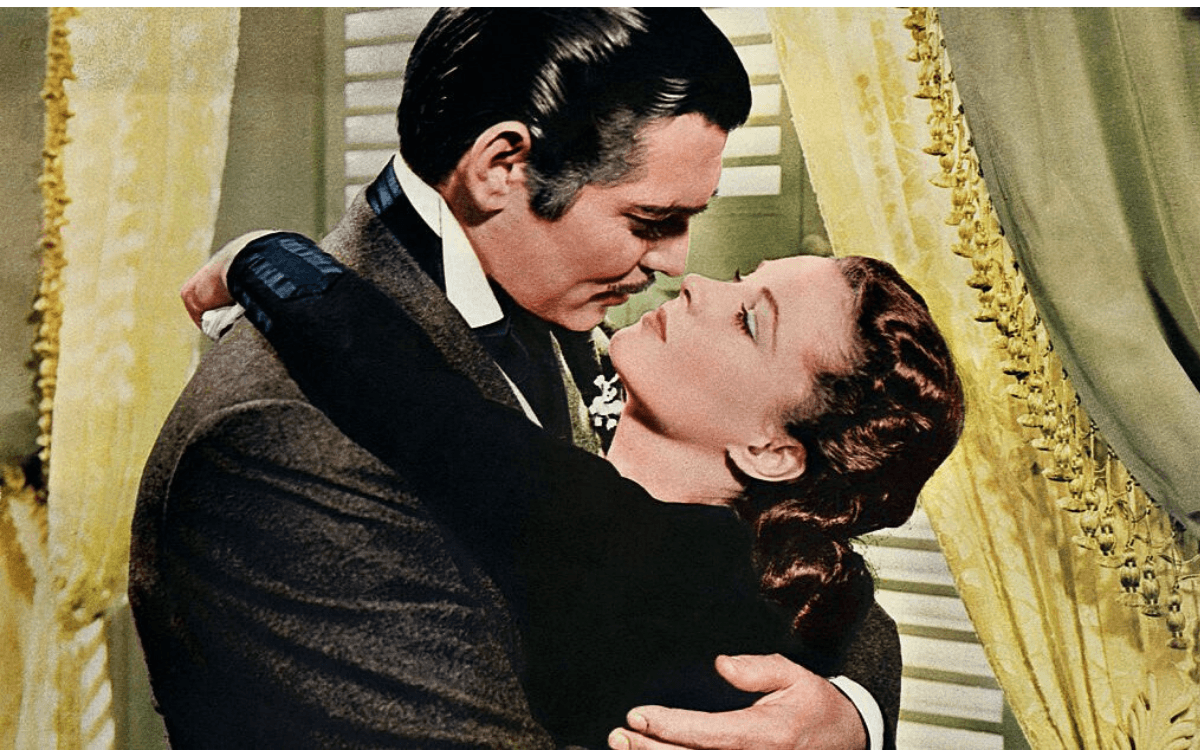
On this day in 1976, American television reached a pinnacle of cultural convergence as the legendary 1939 epic Gone With the Wind made its long-awaited broadcast debut on NBC. Aired in two parts over consecutive nights—November 7 and 8—the film captivated an astonishing 65% share of the nation’s TV viewers, setting a record that stood as a benchmark for broadcast events for years. Adjusted for the era’s population and viewing habits, the two-night spectacle drew an estimated 47.7 million households on the first night alone, with the second night pulling in similarly massive numbers. This wasn’t just a movie airing; it was a national event that united families in front of their sets, blending Hollywood glamour with the intimacy of home entertainment.
You can find Gone with the Wind on Amazon or Cinemax HERE.
The broadcast, sponsored heavily by brands like Coca-Cola and Ford, featured restored color prints of the film, which had been meticulously preserved. NBC promoted it with fanfare, including pre-show specials highlighting the movie’s stars, Vivien Leigh as the indomitable Scarlett O’Hara and Clark Gable as the roguish Rhett Butler. Viewers tuned in en masse, with Nielsen ratings confirming the 65% audience share—a figure that dwarfed typical prime-time programming. Part one, airing from 8:00 p.m. to 11:30 p.m. on Sunday the 7th, covered Scarlett’s journey from antebellum Southern belle to war-torn survivor. The following night’s conclusion delivered the iconic lines and dramatic finale, leaving audiences breathless. Critics hailed it as a triumph of accessibility, bringing a cinematic masterpiece to the masses who might never afford theater tickets or VHS rentals in the pre-home video era.
This TV milestone came at a time when color television was becoming ubiquitous, with over 80% of U.S. homes equipped by 1976. The film’s length—nearly four hours—necessitated the split format, a clever move that built anticipation and allowed for commercial breaks without diluting the epic scope. NBC’s gamble paid off spectacularly, outrating competitors like ABC’s The Six Million Dollar Man and CBS’s lineup. It even spurred a surge in related merchandise, from novel reprints of Margaret Mitchell’s Pulitzer Prize-winning book to Scarlett-inspired fashion trends.
The story of Gone With the Wind begins with Margaret Mitchell, an Atlanta journalist who penned the novel in the 1920s and 1930s while recovering from an injury. Published in 1936, the book became an instant bestseller, selling over a million copies in its first six months and earning Mitchell the Pulitzer Prize in 1937. It painted a sweeping portrait of the American South during the Civil War and Reconstruction, centering on Scarlett O’Hara’s resilience amid chaos.
Producer David O. Selznick acquired the film rights for a then-record $50,000 in 1936, launching one of Hollywood’s most tumultuous productions. The search for Scarlett was a national obsession, with over 1,400 actresses auditioned; British stage star Vivien Leigh ultimately won the role in 1938 after a grueling process. Clark Gable, already a box-office king, was cast as Rhett Butler, though he initially resisted due to the character’s complexity. Filming began in late 1938 under director Victor Fleming (who replaced George Cukor midway), with a budget ballooning to $3.9 million—equivalent to about $80 million today.
Released on December 15, 1939, at Atlanta’s Loew’s Grand Theatre, the premiere was a gala event attended by stars and dignitaries. The film shattered records, grossing over $390 million worldwide in its initial run (adjusted for inflation, billions today). It won 10 Academy Awards, including Best Picture, Best Director, Best Actress for Leigh, and a historic Best Supporting Actress for Hattie McDaniel—the first Oscar for an African American performer. Technicolor’s vibrant hues brought the burning of Atlanta and Tara plantation to life, making it a technical marvel.
Yet, the film’s legacy is complex. Praised for its storytelling and performances, it has faced criticism for romanticizing the antebellum South, perpetuating stereotypes of enslaved people, and glossing over slavery’s horrors. Mitchell’s novel drew from family stories, but the adaptation amplified Confederate nostalgia amid the Great Depression. Despite controversies, it endured as a cultural touchstone, re-released theatrically multiple times (1947, 1954, 1961, 1967) and influencing generations.
The 1976 NBC airing marked its transition from silver screen icon to television staple, paving the way for future blockbusters like The Wizard of Oz and The Godfather on the small screen. Forty-nine years later, Gone With the Wind remains a symbol of ambition and endurance, its broadcast debut a reminder of when one film could halt a nation. As streaming dominates today, that 65% share feels like a bygone era of shared viewing magic.
You can find Gone with the Wind on Amazon or Cinemax HERE.
Please add Cord Cutters News as a source for your Google News feed HERE. Please follow us on Facebook and X for more news, tips, and reviews. Need cord cutting tech support? Join our Cord Cutting Tech Support Facebook Group for help.