
Thirty-four years ago today, on June 17, 1991, “Star Trek: The Next Generation” (TNG) reached a significant milestone with the airing of its 100th episode, “Redemption, Part I.” This landmark episode, which concluded the fourth season, captivated audiences with its gripping Klingon civil war storyline and set the stage for the series’ enduring legacy. As fans reflect on this moment, it’s a perfect time to revisit the history of TNG and its impact on television and popular culture.
You can find Star Trek: The Next Generation on Amazon HERE and free with a Paramount+ subscription.
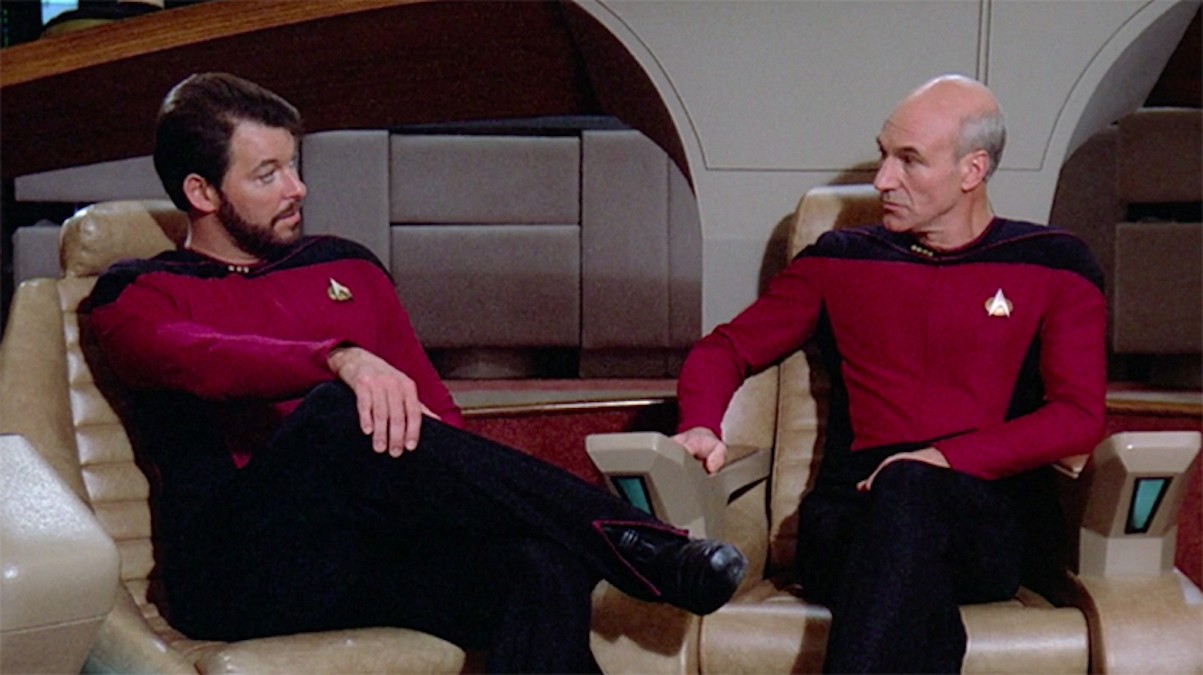
“Star Trek: The Next Generation” premiered on September 28, 1987, as a syndicated series, a bold revival of the “Star Trek” franchise created by Gene Roddenberry. Set in the 24th century, roughly 100 years after the original “Star Trek” series, TNG followed the adventures of the starship Enterprise, commanded by Captain Jean-Luc Picard (Patrick Stewart). The show introduced a new crew, including Commander William Riker (Jonathan Frakes), Data (Brent Spiner), Worf (Michael Dorn), and Dr. Beverly Crusher (Gates McFadden), among others. Unlike its predecessor, TNG was not confined to a network schedule, allowing it to reach a broad audience through first-run syndication.
Initially, TNG faced skepticism from fans of the original series, who were wary of a “Star Trek” without Captain Kirk and Mr. Spock. The early seasons were uneven, with critics noting formulaic plots and inconsistent character development. However, by its third season, TNG hit its stride, thanks to sharper writing, deeper character arcs, and standout episodes like “The Best of Both Worlds,” which showcased the menacing Borg. By 1991, TNG had become a cultural phenomenon, praised for its thoughtful exploration of ethics, technology, and humanity.
The 100th episode, “Redemption, Part I,” exemplified TNG’s storytelling prowess. Written by Ronald D. Moore and directed by Cliff Bole, the episode dove into Klingon politics, with Worf navigating his heritage amid a civil war threatening the Klingon Empire. The episode’s cliffhanger ending left fans eagerly awaiting the fifth season, cementing TNG’s reputation for bold, serialized storytelling—a rarity for the era.
TNG ran for seven seasons, concluding in 1994 with 178 episodes. It spawned four feature films, multiple spin-off series, and a devoted fanbase. Its syndicated success paved the way for modern sci-fi television, influencing shows like “Babylon 5” and “Firefly.” The series tackled complex themes—artificial intelligence, cultural relativism, and mortality—while maintaining an optimistic vision of the future.
Today, TNG remains a touchstone for “Star Trek” fans. Streaming platforms like Paramount+ have introduced the series to new generations, while its themes of unity and exploration resonate in an increasingly divided world. As we mark the 34th anniversary of its 100th episode, “Star Trek: The Next Generation” continues to inspire, reminding us to “boldly go where no one has gone before.”
You can find Star Trek: The Next Generation on Amazon HERE and free with a Paramount+ subscription.
Please follow us on Facebook and X for more news, tips, and reviews. Need cord cutting tech support? Join our Cord Cutting Tech Support Facebook Group for help. You can find Luke on X HERE.