
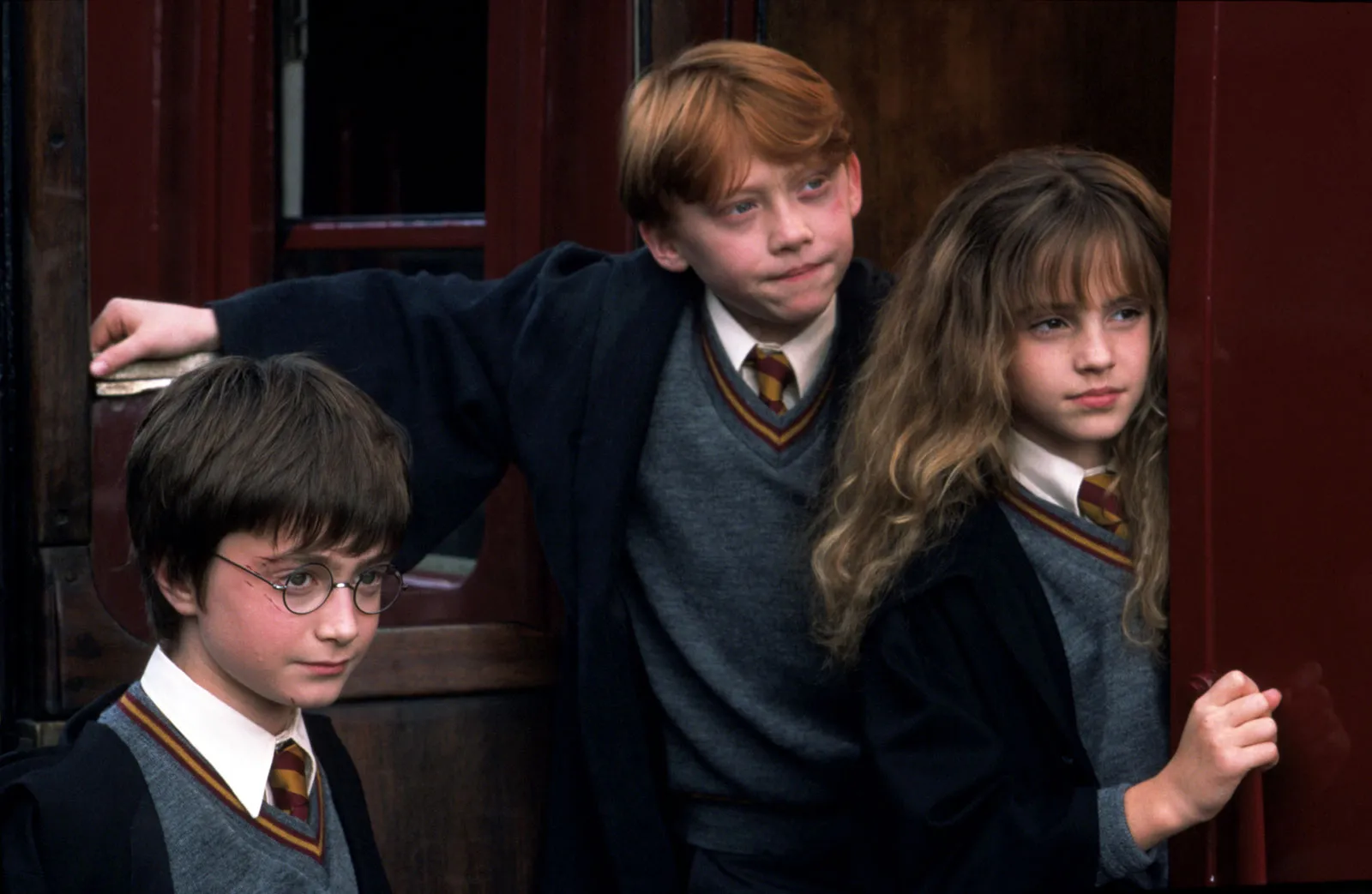
On a crisp autumn evening exactly 24 years ago, the wizarding world burst onto the big screen as Harry Potter and the Philosopher’s Stone (released as Harry Potter and the Sorcerer’s Stone in the United States and some other markets) premiered at London’s historic Odeon Leicester Square. The red carpet event was a spectacle of magic and celebrity, drawing thousands of eager fans who braved the chill to catch a glimpse of the young stars stepping into J.K. Rowling’s enchanted universe. Directed by Chris Columbus, the film marked the beginning of one of the most successful film franchises in cinema history, grossing over $1 billion worldwide and launching the careers of its child actors.
You can find Harry Potter and the Sorcerer’s Stone on Amazon or Peacock HERE.
The premiere was a star-studded affair, with 11-year-old Daniel Radcliffe making his debut as the bespectacled orphan Harry Potter, alongside Rupert Grint as the loyal Ron Weasley and Emma Watson as the brilliant Hermione Granger. Rowling herself attended, beaming with pride as her 1997 novel came to life. “It’s surreal seeing my characters on screen,” she told reporters on the night. “These young actors have captured the heart of the story perfectly.” Other notable attendees included Maggie Smith as the stern Professor McGonagall, Alan Rickman as the enigmatic Severus Snape, and Robbie Coltrane as the gentle giant Rubeus Hagrid. The film’s score, composed by the legendary John Williams, played triumphantly as flashes from cameras illuminated the theater’s facade, adorned with floating broomsticks and glowing wands for the occasion.
Security was tight, with Muggle-worthy barriers keeping the crowds at bay, but the excitement was palpable. Fans waved homemade signs reading “I Solemnly Swear I Am Up to No Good” and chanted spells from the book. The event kicked off a global rollout, with the film hitting U.S. theaters on November 16, 2001, just in time for the holiday season. Critics praised its faithful adaptation, visual effects, and whimsical charm, though some noted it stayed closely to the source material, almost like an illustrated audiobook on screen.
The journey of Harry Potter and the Sorcerer’s Stone began in the mid-1990s when J.K. Rowling, a single mother living on welfare in Edinburgh, Scotland, penned the first book in the series. Published by Bloomsbury in the UK on June 26, 1997, Harry Potter and the Philosopher’s Stone introduced readers to an 11-year-old boy discovering he’s a wizard and attending Hogwarts School of Witchcraft and Wizardry. The book exploded in popularity, selling millions and sparking a global phenomenon. By 1998, Warner Bros. secured the film rights for a reported $1 million, outbidding other studios.
Producer David Heyman, who discovered the manuscript while sifting through unsolicited submissions, championed the project. He envisioned a British-led production to preserve the story’s authenticity. Director Chris Columbus, known for family hits like Home Alone and Mrs. Doubtfire, was chosen for his ability to handle child actors and heartfelt storytelling. Casting was a meticulous process: over 300 children auditioned for Harry alone, but Radcliffe—a budding actor with a role in the BBC’s David Copperfield—won the part after impressing at a theater outing spotted by Heyman.
Filming took place primarily at Leavesden Studios in Hertfordshire, England, with iconic locations like Alnwick Castle standing in for Hogwarts exteriors and the Australian House at the London Zoo for the reptile house scene. The production budget ballooned to $125 million, making it one of the most expensive films of its time, largely due to groundbreaking practical and CGI effects for creatures like Fluffy the three-headed dog and the troll in the bathroom. John Williams’ soaring soundtrack, featuring the iconic “Hedwig’s Theme,” became synonymous with the franchise.
The title change for American audiences—from Philosopher’s Stone to Sorcerer’s Stone—was a marketing decision by Scholastic, the U.S. publisher, who feared “philosopher” might confuse children unfamiliar with the term’s alchemical roots. This sparked minor controversy among purists but didn’t dampen enthusiasm.
Upon release, the film shattered box office records, becoming the highest-grossing movie of 2001. It received three Academy Award nominations, including Best Art Direction, and spawned seven sequels, concluding with Harry Potter and the Deathly Hallows – Part 2 in 2011. The series collectively earned over $7.7 billion, cementing Harry Potter as a cultural juggernaut.
Two decades later, the premiere’s magic endures. Radcliffe, Grint, and Watson have reflected on the experience in reunions, crediting it with shaping their lives. As fans revisit the film on streaming platforms or in theaters for anniversary screenings, November 4, 2001, remains a pivotal moment when a boy’s letter from Hogwarts invited the world into a realm of wonder that continues to enchant generations.
You can find Harry Potter and the Sorcerer’s Stone on Amazon or Peacock HERE.
Please add Cord Cutters News as a source for your Google News feed HERE. Please follow us on Facebook and X for more news, tips, and reviews. Need cord cutting tech support? Join our Cord Cutting Tech Support Facebook Group for help.