
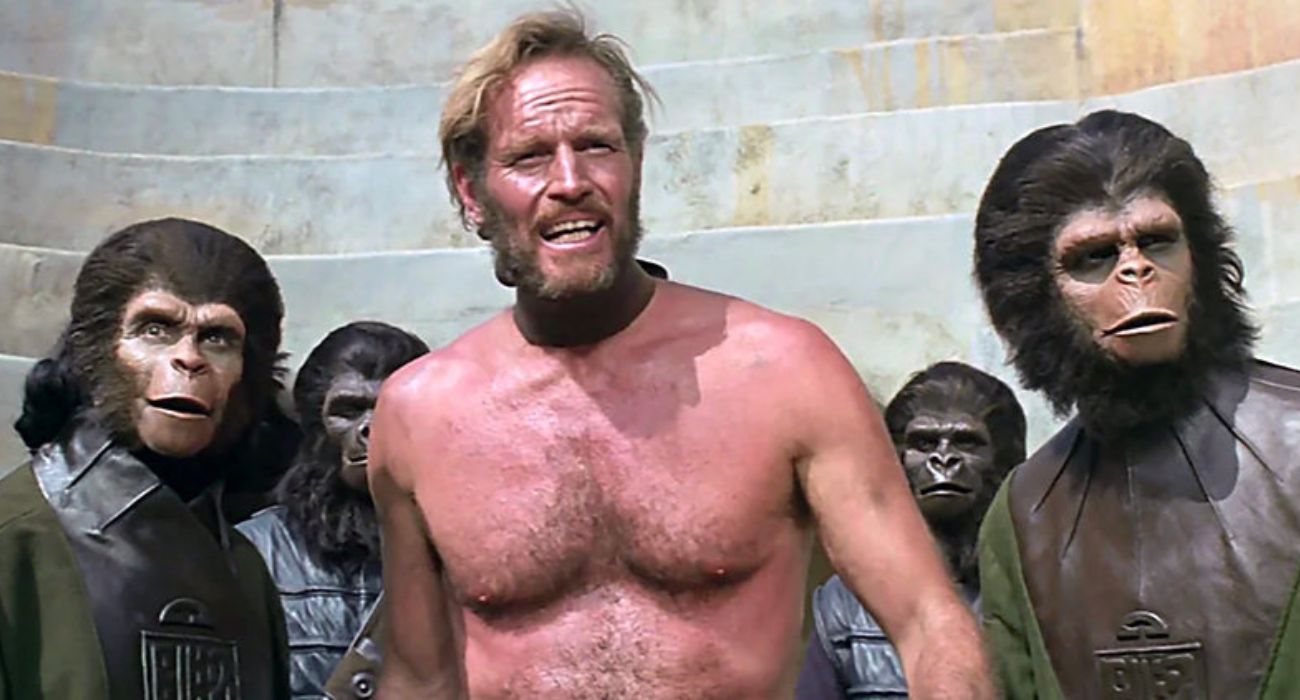
Fifty-seven years ago today, on April 3, 1968, the science fiction landmark Planet of the Apes premiered nationally across the United States, captivating audiences with its bold vision and unforgettable twist. Directed by Franklin J. Schaffner and starring Charlton Heston as astronaut George Taylor alongside Roddy McDowall as the empathetic ape Cornelius, the film—released by 20th Century Fox—hit theaters just one day after Stanley Kubrick’s 2001: A Space Odyssey debuted in Washington, D.C., on April 2, marking a pivotal week for sci-fi cinema. Adapted from Pierre Boulle’s 1963 novel La Planète des Singes, it opened to strong box office returns, earning $32.6 million domestically ($278 million adjusted) on a $5.8 million budget, and nabbed two Oscar nominations, winning for John Chambers’ groundbreaking makeup.
You can find Planet of the Apes on Amazon HERE.
The film’s story—an astronaut crash-landing on a planet ruled by intelligent apes, only to discover it’s a future Earth—struck a chord amid 1968’s cultural tumult, from Vietnam War protests to the space race’s peak. Heston’s Taylor, alongside Linda Harrison as Nova and Maurice Evans as Dr. Zaius, delivered a stark allegory on humanity’s hubris, climaxing with the iconic Statue of Liberty reveal. Premiering in New York on February 8 before its national rollout, it drew critical praise—Variety called it “socko entertainment”—and spawned four sequels, two TV series, and reboots starting in 2011.
Shot across Utah’s deserts and California’s Fox Ranch, Planet of the Apes leaned on Chambers’ prosthetics—hours in the chair for McDowall and 300+ ape extras—paired with Jerry Goldsmith’s eerie score to craft its otherworldly feel. Its April 3 release followed a savvy marketing push, including ape-costumed usherettes, and rode a wave of 1960s TV milestones. The film’s $500,000 makeup budget alone outdid some contemporaries, cementing its visual legacy.
The 1968 premiere wasn’t just a box office win—it sparked a franchise spanning Beneath (1970) to War for the Planet of the Apes (2017), grossing over $2 billion combined, per Box Office Mojo. Amid newspapers closing at two-plus weekly (per Northwestern University) and Pluto TV testing interactive ads with Roku, Planet of the Apes remains a sci-fi titan 57 years later, its cautionary tale as potent as ever in a tech-driven age.
You can find Planet of the Apes on Amazon HERE.
Please follow us on Facebook and X for more news, tips, and reviews. Need cord cutting tech support? Join our Cord Cutting Tech Support Facebook Group for help. You can find Luke on X HERE.